

Control Is the ‘Holy Grail’: CHD Panel Debates Geoengineering, Earth’s Future
Five prominent critics of modern technocratic systems joined Children’s Health Defense CEO Mary Holland on CHD.TV to debate geoengineering, weather modification and growing threats to human health.

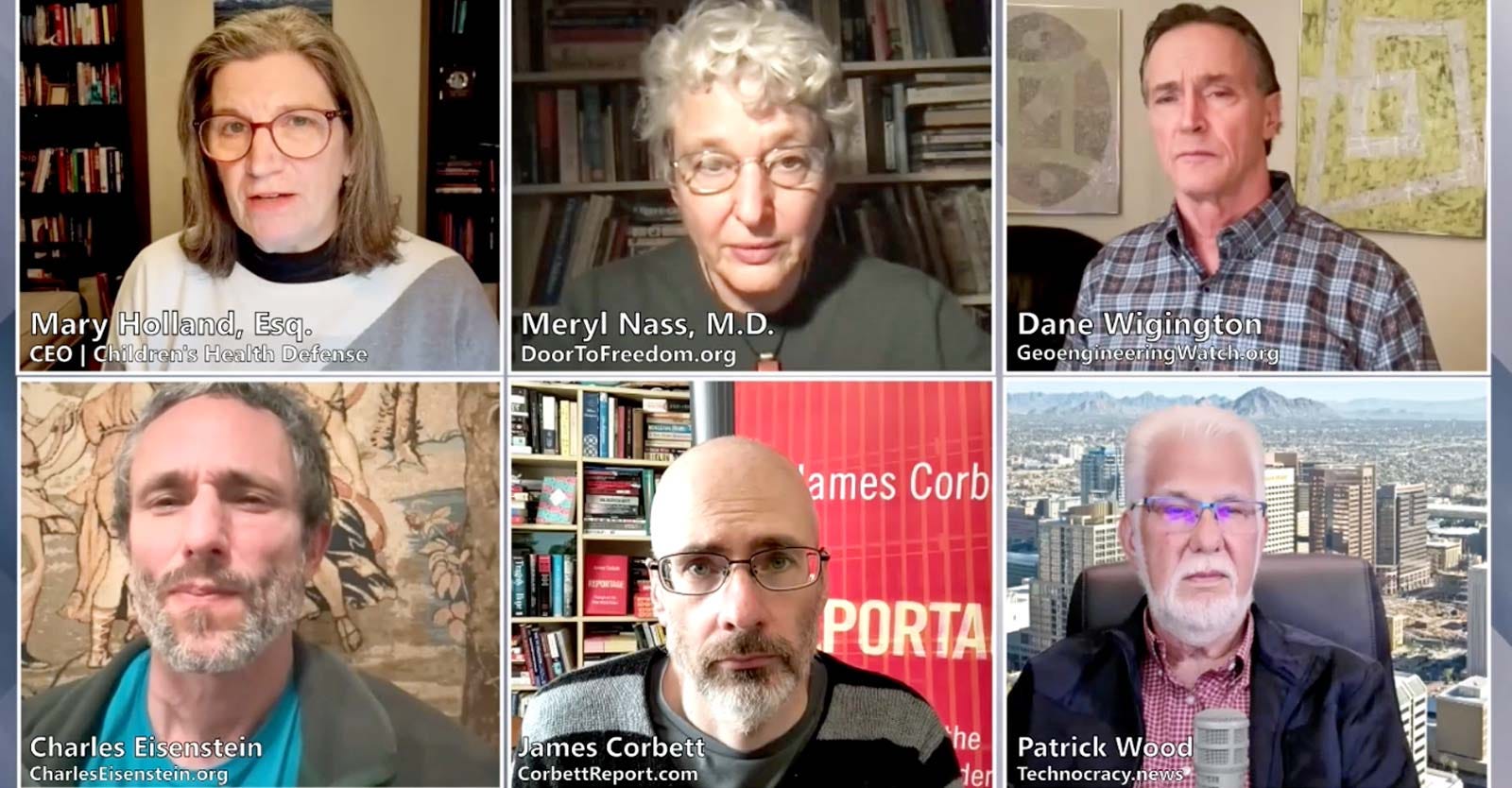
Five prominent critics of modern technocratic systems joined Children’s Health Defense (CHD) CEO Mary Holland on CHD.TV to debate the causes and possible responses to geoengineering, weather modification, and growing threats to environmental and human health.
“I think probably we all agree that this is happening on a very large scale,” Holland said, “but one that … has basically been obscured by the press, and even the scientific community.”
Panelists, who included author and public intellectual Charles Eisenstein, Geoengineering Watch founder Dane Wigington, independent journalist James Corbett, technocracy researcher Patrick Wood, and physician and bioweapons expert Dr. Meryl Nass, also disagreed about some of the primary threats facing society today.
Holland framed the debate as an inquiry into the “health of the planet” and the forces shaping climate, food systems and government.
Did climate modification play role in latest massive storm?
The conversation opened with a focus on the massive storm blanketing the U.S. and whether it may be related to ongoing weather and climate modification.
Wigington argued the storm was directly tied to large-scale, ongoing climate engineering operations.
He argued that these technologies, which he said are documented in decades-old patents, are being actively deployed and significantly altering weather patterns.
Corbett suggested that weather modification has historically been reported as a future or experimental concept, despite decades of acknowledged practices such as cloud seeding. This framing obscures the continuity between past programs and current developments, which in turn limits public scrutiny, he said.
Holland said that although the skies today look different from those of a decade ago, until recently, anyone who raised the issue of geoengineering was treated as though they were wearing a “tin foil hat.”
Not all panelists shared Wigington’s certainty that the recent storm was a result of geoengineering, or that geoengineering poses the primary threat to humanity today.
Control of nature is ‘the holy grail’
Eisenstein offered a broader philosophical perspective. He suggested that even without intentional geoengineering, large-scale ecological destruction — deforestation, ocean depletion, loss of biodiversity — has impaired Earth’s ability to self-regulate.
“The impulse or compulsion to attempt to modify the weather is completely natural to the mindset of science as it has developed over centuries, where the holy grail is to develop perfect control over nature and perfect control over the body,” Eisenstein said.
He described Earth as a living system whose “organs” are being degraded, resulting in increasingly unstable weather and environmental conditions.
Eisenstein didn’t outright dismiss geoengineering. However, he cautioned against focusing exclusively on technological interventions without addressing the underlying worldview that treats nature as an object to be controlled rather than a living system.
Corbett agreed. He suggested that the heart of the problem is “the desacralization of nature.”
‘Ability to control everything requires the ability to control land and nature’
Wood traced modern geoengineering and environmental governance to what he described as a technocratic ideology dating back to the early 20th century, and later formalized through U.N. initiatives, including Agenda 21, the global plan for “sustainable development.”
He argued that these frameworks have long sought to create centralized management of land, resources and populations, often under the banner of sustainability.
Nass connected geoengineering concerns to the broader issues of surveillance, financialization and control, including digital currencies, land “tokenization” and centralized food systems.
“Part of the ability to control everything requires the ability to control land and nature,” she said.
While governments publicly acknowledge weather research, they often deny active weather modification, Nass said. She disagreed with Wigington’s assessment of the existential threat posed by geoengineering alone.
However, she said that such projects by government and military ought not to be allowed to remain “in the dark.”
Holland agreed. “One of the difficulties with looking at this is that it’s so opaque … and that’s obviously been intentional.”
State legislative efforts may prompt broader debate
Participants discussed recent state-level legislative efforts to restrict or ban geoengineering activities.
They said that while such bills may face enforcement challenges — given federal authority over airspace — they can still raise public awareness and prompt broader debate.
Wigington argued that meaningful change would require widespread public understanding, particularly among military personnel and defense contractors, whom he believes are directly involved in such programs.
He framed geoengineering as part of a larger “omniwar” against natural systems, using a concept Wood introduced to describe converging pressures on air, water, food and human autonomy.
Geoengineering: part of a larger ‘ominwar’ against natural systems?
Despite sharp disagreements on specifics, the panel converged on the idea that public disengagement and uncritical acceptance of official narratives enable harmful policies to persist.
Wood said the concept of “omniwar” — a multifaceted war being waged on humanity — is a useful framework for the contemporary problem.
He said geoengineering was part of that. However, the broader “omniwar” concept allows people to fight against the larger, ongoing assault on humanity, including the attack on food, health, the environment and critical thinking, that resonate with them.
Corbett and Wood emphasized the need for critical thinking and decentralized action. Eisenstein called for a deeper cultural shift away from domination and control toward ecological humility.
The panelists concluded that environmental and technological challenges can’t be separated from questions of power, belief systems and public consent — and that addressing them will require both practical action and a fundamental reassessment of humanity’s relationship with nature.
Watch the panel here:

Related stories in The Defender
Add geoengineering to the other assaults on the planet eco systems... Its pharmakia in all cases initially ...then fubbeling around with fixes that also don't work
Control of nature is the holy grail, success with that… Wildfires everywhere on Mother Earth (LA, Australia,…)inundations unstoppable and in places never occurred before, southern France becoming an extension of Sahel, Tsunamis and inundations just let me know where they are not returning on a regular base, sea level more going up than going down, and excuse me there hasn’t been any of this when I look around that people are drowning even without a life threatening urge.